- U.S. Taps Emergency Heating Oil Reserves as Winter Heating Costs Surge
- Major Oil Companies Post Record Q3 Earnings as Refining Margins Remain Elevated
- Trump Pauses Further Strikes on Iran, Easing Geopolitical Risk Premium in Oil Markets
- OPEC Production Rebounds Toward Pre-War Levels as Saudi Output Recovers
U.S. Taps Emergency Heating Oil Reserves as Winter Heating Costs Surge
- The U.S. Department of Energy (DOE) awards contracts to loan 300,000 barrels of fuel oil, about 30% of the Northeast Home HO Reserve, to four companies in an effort to alleviate regional supply constraints ahead of winter.
- The EIA projects average household heating oil expenditures will increase 21% this winter to $2,115, the largest increase among major heating fuels, with average heating oil prices forecast at $5.26/gallon, up 34% year-over-year.
- Tightening global distillate production and persistent East Coast inventory deficits are expected to maintain upward pressure on heating oil and ULSD markets throughout the winter, despite some anticipated demand relief from milder temperatures.
The DOE recently announced plans to loan 300,000 barrels from its Northeast Home Heating Oil Reserve, with deliveries originating from storage facilities in Boston and New Haven. The volumes will be distributed among global companies such as Trafigura and Vitol to improve regional fuel availability and provide some much-needed relief heading into winter.
The EIA’s 2026-2027 Winter Fuels Outlook highlights the tightening supply environment, forecasting average HO prices of $5.26/gal this winter, a significant increase from last year. Average household expenditures are expected to reach $2,115, up 21% from last year, as we enter the season with PADD 1 distillate inventories already 24% below the 5-year average.
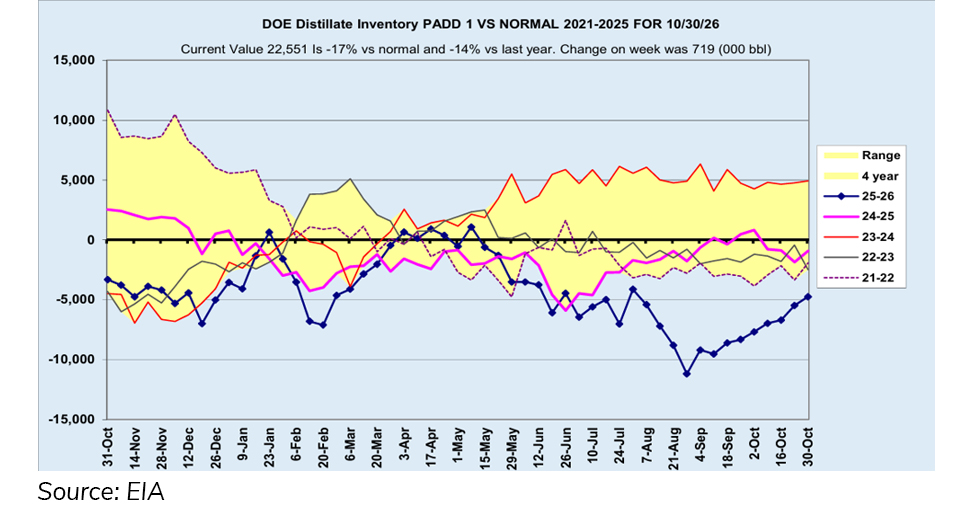
Despite expectations for a milder Northeast winter to reduce HO consumption by approximately 9%, underlying supply constraints remain a concern. The emergency reserve loan may provide localized relief, but its relatively small volume is unlikely to materially shift broader distillate balance.
Major Oil Companies Post Record Q3 Earnings as Refining Margins Remain Elevated
- ExxonMobil, Chevron, Shell, BP, and TotalEnergies all exceeded third-quarter earnings expectations, marking a second consecutive exceptionally strong quarter for major oil companies.
- ExxonMobil reported $17.5 billion in adjusted earnings, while Chevron generated $10.4 billion, with both companies benefiting from exceptionally strong downstream performance.
- Refining margins surged as geopolitical disruptions, refinery outages, and reduced global fuel production tightened gasoline and distillate supplies, driving downstream profitability to multi-year highs.
Major oil companies reported some of their strongest quarterly results in years as elevated refining margins significantly boosted downstream profitability. ExxonMobil generated $17.5 billion in adjusted earnings, with its Energy Products segment reaching a record $9.05 billion, nearly five times its year-ago earnings. Chevron reported $9.9 billion in net income, nearly triple the prior-year quarter, as U.S. downstream earnings surged to $3.58 billion from $638 million. The strength in refining has been particularly notable as downstream earnings have increasingly offset softer upstream results from lower crude realizations.
The surge in profitability reflects a tightening global refining environment, driven by geopolitical disruptions, infrastructure damage, and reduced available processing capacity. Disruptions to crude and refined product flows through the Middle East, combined with refinery outages and operational constraints, have limited global fuel production while maintaining strong demand for available barrels. Refiners operating at high utilization have consequently benefited from wider gasoline and diesel cracks. Exxon operated its U.S. Gulf Coast crude units at 100% utilization and achieved its second-highest U.S. Gulf Coast diesel production on record, while Chevron set a company record of 1.09 million barrels per day in refinery crude throughput at nearly 98% utilization.
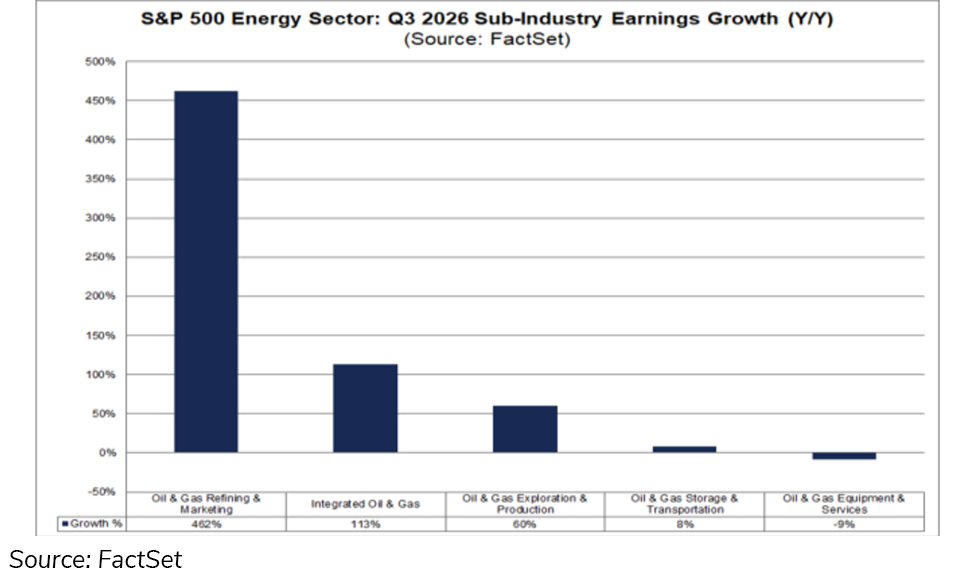
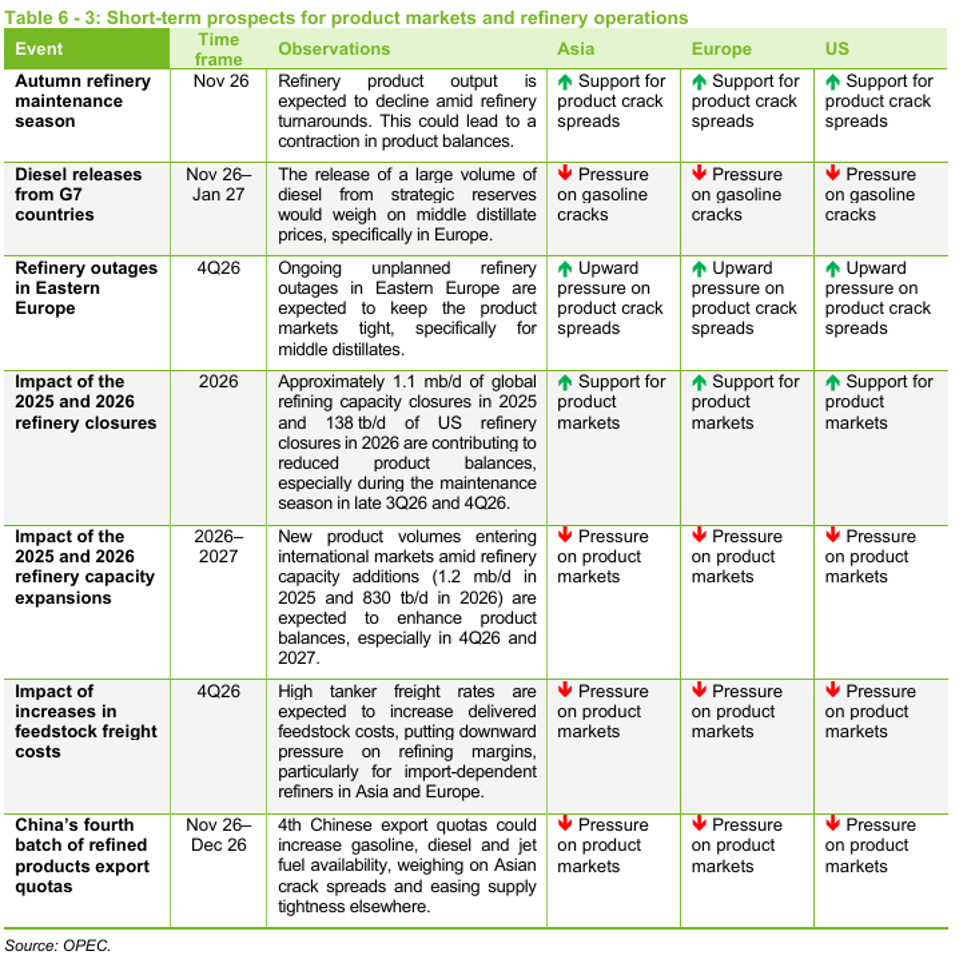
This downstream strength is consistent with the broader performance of middle-distillate markets, where the NYMEX HO/WTI crack averaged $108.60/bbl in September and $104.20/bbl in October before easing to approximately $91.10/bbl in November. Although cracks have compressed in recent weeks, they remain historically elevated, highlighting the persistent tightness in global diesel supply and the favorable refining environment that supported Q3 earnings. Continued refinery constraints, geopolitical disruptions, and seasonal heating demand will remain key factors influencing margins heading into winter.
Trump Pauses Further Strikes on Iran, Easing Geopolitical Risk Premium in Oil Markets
- In the 2nd week of November, Trump has stated the U.S. would hold off additional major strikes against Iran, following diplomatic appeals from Qatar and other Gulf nations.
- Crude prices fell sharply as markets priced out some of the risk of further escalation, with Brent settling down 5.85% on Monday, November 9th and reaching its lowest level since August.
- Despite the pause, the Strait of Hormuz blockade and continued shipping disruptions remain significant risks, limiting the potential for a sustained decline in oil prices.
President Trump’s decision to hold off on further strikes against Iran has eased some of the geopolitical risk premium that had supported crude prices throughout the conflict. The U.S. still plans to maintain the current military posture rather than immediately resume large scale attacks, with the hope that further cooperation will occur.
The crude pullback does not necessarily represent a signal to return to normal in global energy markets. The U.S. naval blockade remains in place, commercial shipping through the Strait of Hormuz continues to face security risks, and negotiations between Washington and Tehran remain completely unresolved.
Crude Oil 11/11:
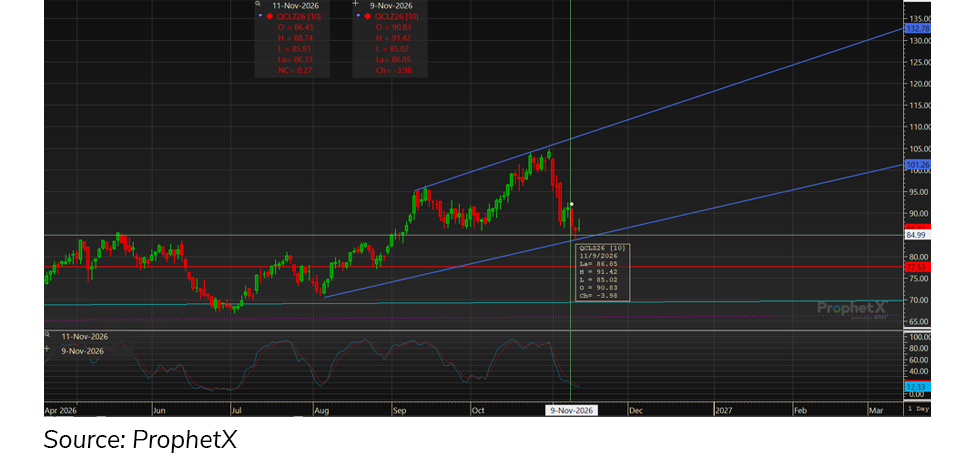
If military activity continues to subside and diplomatic negotiations make progress, crude prices could see further relief from the elevated levels experienced over the past several months. However, until shipping flows through the Strait of Hormuz normalize, a meaningful geopolitical risk premium is likely to remain embedded in oil prices.
OPEC Production Rebounds Toward Prewar Levels as Saudi Output Recovers
OPEC production moved closer to prewar levels in October as Saudi Arabia and other Gulf producers increasingly relied on alternative export routes and logistical workarounds to keep crude moving. Saudi crude exports averaged approximately 7 million b/d during the month, remaining above their 2025 average of 6.2 million b/d. Cross-country pipelines, ship-to-ship transfers, and alternative shipping routes have helped offset some of the disruptions caused by continued threats to vessels in the Strait of Hormuz and Red Sea.
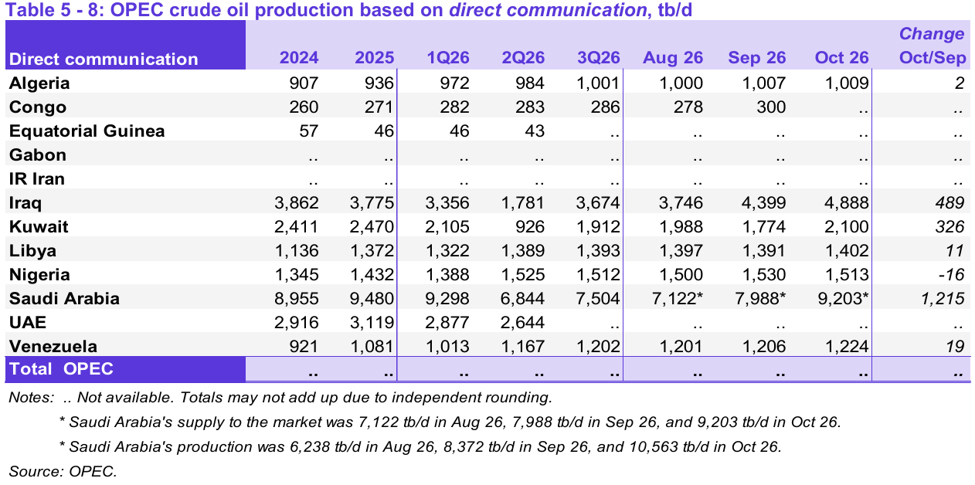
However, the recovery in production has not translated into a comparable recovery in global crude shipments. Confirmed transits through the Strait of Hormuz remain approximately 76% below prewar levels, highlighting the continued disconnect between crude being produced and crude successfully reaching international buyers. Gulf exporters are also offering significant discounts to offset elevated tanker and freight costs, with Saudi Aramco reducing its December Arab Light selling price to Asian customers by $2/bbl to a $7/bbl discount to the Oman/Dubai benchmark.
For oil markets, the production rebound provides some relief to global supply concerns, but transportation constraints continue to limit the amount of crude reaching the market. Until shipping flows through the Strait of Hormuz normalize, the recovery in OPEC production alone may not be enough to materially ease physical supply tightness or eliminate the geopolitical risk premium embedded in crude prices.
Sources:
- Energy Information Administration (EIA)
- The Economic Times
- Yahoo Finance
- FactSet Insight
- Seeking Alpha
- WSJ
- MSN
- The Independent
- OPEC