- Trump’s Executive Action Regarding Dyed Diesel
- G7 Plans to Release 100M Emergency Reserve Barrels of Diesel and Crude Four-Month Period
- Hurricane Isaias & Gulf Coast Supply Disruptions
- Russian Diesel Release
- Widening Global Diesel Supply Deficit & the Impact on Refinery Margins
Trump’s Executive Action Regarding Dyed Diesel
We are closely monitoring President Trump’s “Emergency Tax Relief on Diesel Fuel” Executive Order, which is intended to provide temporary federal relief from high fuel prices by authorizing the use of off-road dyed diesel fuel in highway vehicles. We recognize that this development may raise questions for our customers and may offer the prospect of lower diesel costs.
The executive action directs the Treasury Department to defer, without interest or penalties, the federal excise tax that would ordinarily apply when dyed diesel is sold or used for on-road purposes during the temporary relief period from October 5 through December 31, 2026. It is important to note that a deferral is different from tax forgiveness, and the obligation may become due later unless Congress or subsequent federal guidance provides otherwise. The executive action also encourages states to offer similar relief, but their responses may vary. As a result, customers operating across state lines should remain mindful that tax requirements and enforcement practices may differ by jurisdiction.
To help protect our customers from unexpected compliance or operational issues, Guttman Energy recommends continued caution before using dyed fuel for routine on-road operations, while the IRS and state authorities clarify implementation, enforcement, and applicable tax obligations.
Additional considerations include residual dye in vehicle tanks and fuel systems, future tax liability, and penalties in states that do not adopt similar relief or after the temporary relief period ends.
The above information is provided for general information purposes only. Our customers should consult their own legal counsel and/or tax advisor regarding their specific circumstances and applicable laws and regulations.
As always, you can continue to count on Guttman for strategic market guidance, comprehensive energy solutions, competitive pricing, and reliable fuel delivery.
Thank you for your continued business and support.
G7 Plans to Release 100M Emergency Reserve Barrels of Diesel and Crude Over 4-Month Period
- On Oct 2nd, G7 countries laid out a plan to inject 100M barrels of crude and distillate stocks from strategic reserves into the open market, front- loading a significant portion of diesel in the next 2-3 weeks
- Specific release schedules and country-by-country allocations, were not initially disclosed
The release specifically targets tight diesel and distillate markets, where low inventories and disruptions to Middle Eastern supply flows have pushed prices and refining margins higher. Additional barrels could provide near-term relief to ULSD prices and diesel cracks, but the impact will depend on actual delivery timing, product availability, and whether geopolitical disruptions persist.
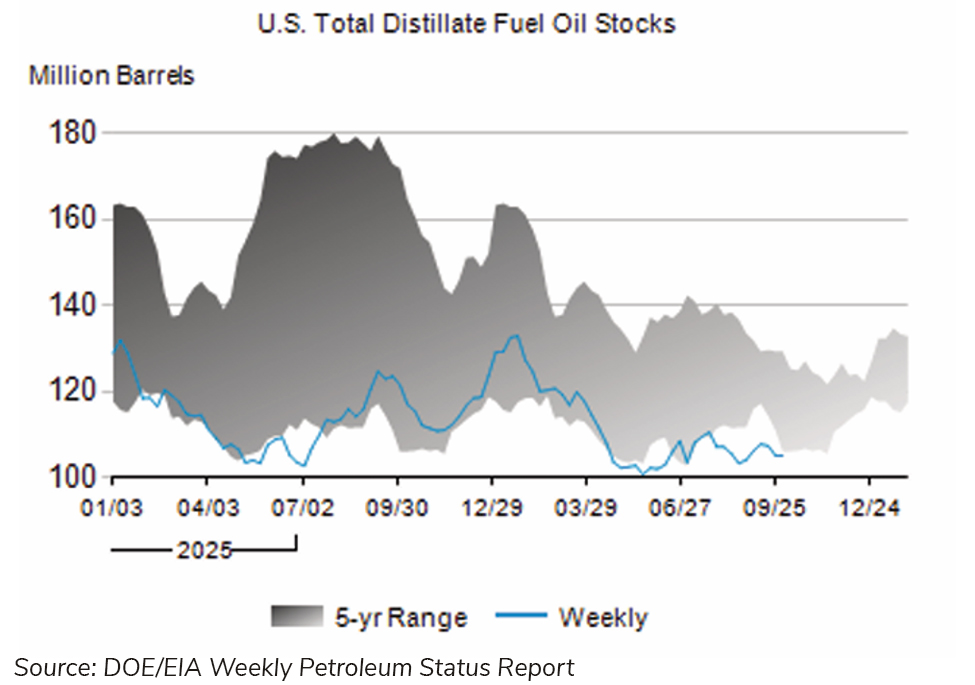
The release is bearish in the short-term by adding supply and potentially easing prompt-market tightness. However, it is unlikely to resolve the broader distillate shortage on its own. Current USA distillate inventories sit 13% below the five-year average, and as peak demand and midterm season approaches, all eyes are on America’s ability to ease current elevated diesel prices.
Hurricane Isaias & Gulf Coast Supply Disruptions
- Hurricane Isaias made landfall near Destin, Florida on October 9th as a Category 2 hurricane after briefly reaching Category 3 strength
- Offshore operators shut in significant crude and natural gas production and evacuated platforms ahead of landfall
Since October 9th, 130 production platforms and rigs have been evacuated, resulting in production shut-ins of 63% or 1.3 million barrels per day of crude oil and 57% or 1.1 billion million cubic feet per day of natural gas. PADD 3 refineries have been operating at some of the highest utilization rates, around 95%, for the week that ended October 2nd. The current hurricane path is expected to impact Chevron’s Pascagoula and Vertex’s Saraland refineries..
These refineries alone produce 466,000 barrels per day, which make up 2.6% of all US refining capacity. At a time when distillate inventories are already extremely tight, any further disruptions have the ability to significantly impact PADD 3 basis prices, and ULSD prices nationally.
Russian Diesel Release
The deal aims to provide sustained ULSD price relief to both the U.S. and international markets over the next 2–4 months, as global diesel prices remain at historically elevated levels. The total commitment of 4.8 million metric tons equates to approximately 35.8 million barrels of diesel. For context, U.S. distillate demand is roughly 3.8 million barrels per day, making the full commitment equivalent to approximately 9.4 days of U.S. demand. However, the supply is intended for the global market and will be released over time, meaning the actual impact on U.S. availability will depend on shipment volumes, delivery schedules, and destination markets.
Following the October 9th announcement, the NYMEX ULSD crack spread against WTI fell $6.45/bbl. to $96.80/bbl. during the trading session. This suggests that the market quickly began pricing on the potential for additional diesel supply, despite no confirmation that physical deliveries had begun. The move reflects a near-term shift in market sentiment, with the prospect of additional barrels easing some concerns around global distillate tightness.
However, questions remain regarding Russia’s ability to fulfill the commitment. Persistent Ukrainian drone strikes have disrupted Russian refining operations, with an estimated 3.1 million barrels per day of refining capacity reportedly offline in early October. Additionally, Russian diesel exports, which averaged approximately 1 million barrels per day during the first half of 2026, have reportedly fallen by roughly half since then. These constraints raise doubts about whether Russia can deliver the promised volumes on schedule while maintaining its existing export commitments amid ongoing wartime disruptions. Ultimately, the bearish impact on ULSD will depend less on the headline commitment and more on Russia’s ability to restore refining capacity, sustain export flows, and deliver additional barrels to the market.
A Widening Global Diesel Supply Deficit and the Impact on Refinery Margins
- Refinery margins remain highly elevated as crack spreads reflect tight global diesel supply and continued geopolitical uncertainty
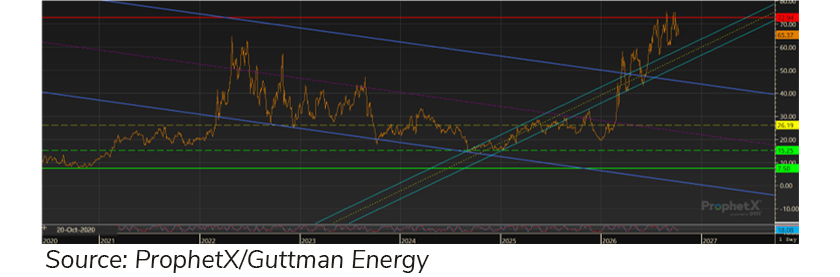
- The 3-2-1 crack spread has reached record levels, driven primarily by exceptionally strong middle-distillate margins
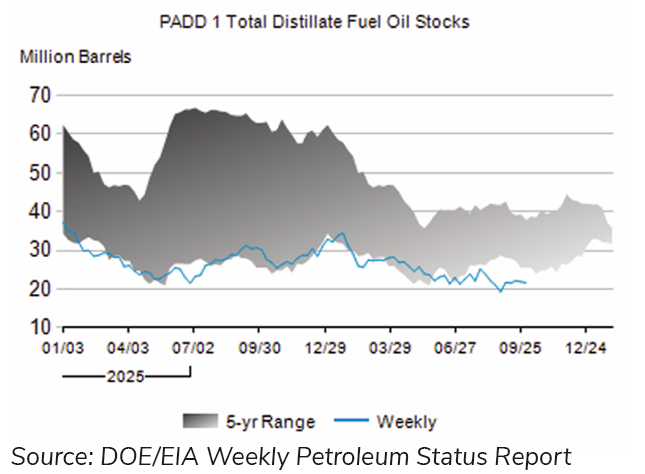
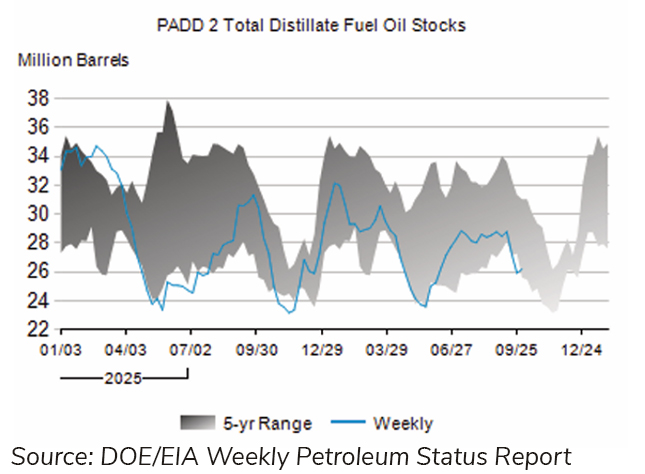
- US distillates remain 13% below 5-year averages, with PADD 1 inventory -28.2% below previous year’s levels and PADD 2 -14%
Refinery margins strengthened throughout the third quarter of 2026 as global supply disruptions pushed refined-product prices higher relative to crude oil. U.S. refinery utilization averaged approximately 95% during the quarter, while distillate and jet fuel crack spreads nearly tripled their year-ago levels. This reflects a market in which the primary constraint is increasingly the availability of refined products rather than crude oil alone. With refiners already running at elevated rates, additional production may be insufficient to quickly restore inventories to historical levels.
The global distillate market remains particularly vulnerable to further disruptions. U.S. distillate inventories were 13% below their five-year average for the week ending September 25, while disruptions to Russian, Chinese, and Middle Eastern refining operations have constrained exportable diesel supplies. Strong international demand has also encouraged U.S. refiners to direct barrels toward export markets, tightening the domestic supply cushion. These conditions continue to support ULSD cracks and physical differentials, particularly when unplanned outages or shipping disruptions emerge.
Looking ahead, sustained relief will depend on the recovery of disrupted refining capacity, increased export availability, and meaningful inventory rebuilding. Although additional Russian diesel shipments and strategic stock releases could ease prompt-market tightness, their impact will depend on actual delivery volumes and timing. The EIA expects distillate inventories to remain below their five-year average throughout its forecast period, suggesting that diesel cracks may remain elevated relative to historical norms even if crude prices decline. For the ULSD market, the key signal will be whether physical inventories begin rebuilding consistently – not simply whether crude prices retreat or additional supply is announced.
Sources:
- Energy Information Administration (EIA)
- CBS
- Seeking Alpha
- MSN
- AP News
- S&P Platts