- Diesel Markets Tighten as Global Supply Risks Collide with Peak Seasonal Demand
- OPEC+ Maintains October Production Targets as Market Remains Balanced
- U.S. Refiners Operating Near Maximum Capacity
- Potential Venezuela Oil Deal Could Add Future Crude Supply
- Hurricane Season Adds Another Layer of Risk to Tight Product Markets
- Strategic Petroleum Reserve Falls to Lowest Level Since 1982
Diesel Markets Tighten as Global Supply Risks and Planned Refinery Maintenance Collide with Peak Seasonal Demand
- Global diesel supply remains unusually tight as reduced Russian exports and Middle East disruptions push prices and refining margins higher.
- Peak seasonal demand across North and South America is leaving markets with limited inventory buffers and little room for additional supply disruptions.
Diesel markets across the Americas are entering peak seasonal demand with unusually low supply buffers. A global diesel deficit, driven by reduced exports from Russia and disruptions in the Middle East, has significantly tightened supply and pushed diesel prices and refining margins to record highs. At the same time, demand is rising as South American planting season, North American harvest activity, and winter heating preparations all increase diesel consumption.
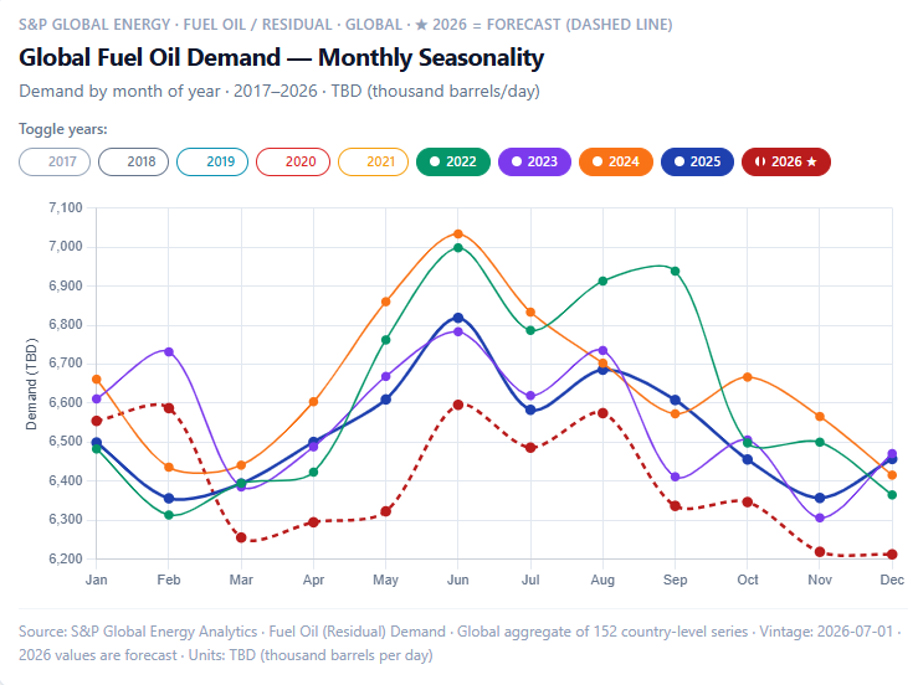
Diesel markets across the Americas are entering peak seasonal demand with unusually low supply buffers. A global diesel deficit, driven by reduced exports from Russia and disruptions in the Middle East, has significantly tightened supply and pushed diesel prices and refining margins to record highs. At the same time, demand is rising as South American planting season, North American harvest activity, and winter heating preparations all increase diesel consumption.
OPEC+ Maintains October Production Targets as Market Remains Balanced
- OPEC+ maintained October 2026 production targets, signaling confidence that current output levels are appropriate amid prevailing market conditions.
- The group reaffirmed its commitment to full compliance with production agreements and will continue monthly market reviews, with the next meeting scheduled for October 4.
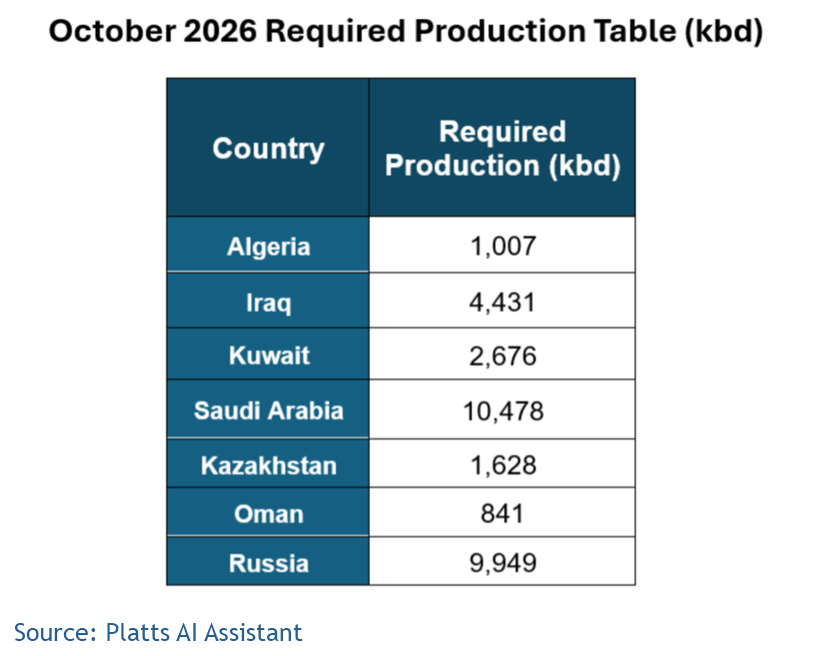
OPEC+ signaled a steady approach to oil market management after seven member countries, including Saudi Arabia and Russia, agreed to maintain their September 2026 required production levels through October 2026. The decision reflects the group’s assessment that current market fundamentals remain balanced and that no immediate supply adjustments are necessary. Participating countries also reaffirmed their commitment to full compliance with the Declaration of Cooperation and previously announced voluntary production adjustments. Continued adherence to agreed production targets should help support market stability as the industry monitors demand trends, economic conditions, and geopolitical developments. OPEC+ will continue its monthly review process, with the next meeting scheduled for October 4, 2026.
U.S. Refiners Operating Near Maximum Capacity
- U.S. refinery utilization reached 98%, its highest level since 2018, highlighting exceptionally strong demand for refined products and sustained operational performance.
- Limited spare refining capacity leaves the market more vulnerable to potential disruptions, maintenance events, or unexpected supply outages.
U.S. refinery utilization recently climbed to 98%, marking the highest operating rate since 2018 and underscoring the strong demand being placed on the nation’s refining system. The elevated utilization rate reflects refiners maximizing output to meet consumption needs and support fuel markets. While high operating rates are helping maintain product supply, they also indicate that little spare refining capacity remains available. This limited operational cushion could amplify the impact of unplanned outages, weather-related disruptions, or maintenance events on refined product balances and pricing.
The current environment highlights the importance of refinery reliability as market participants continue to monitor fuel demand trends and downstream supply conditions.
Potential Venezuela Oil Deal Could Add Future Crude Supply
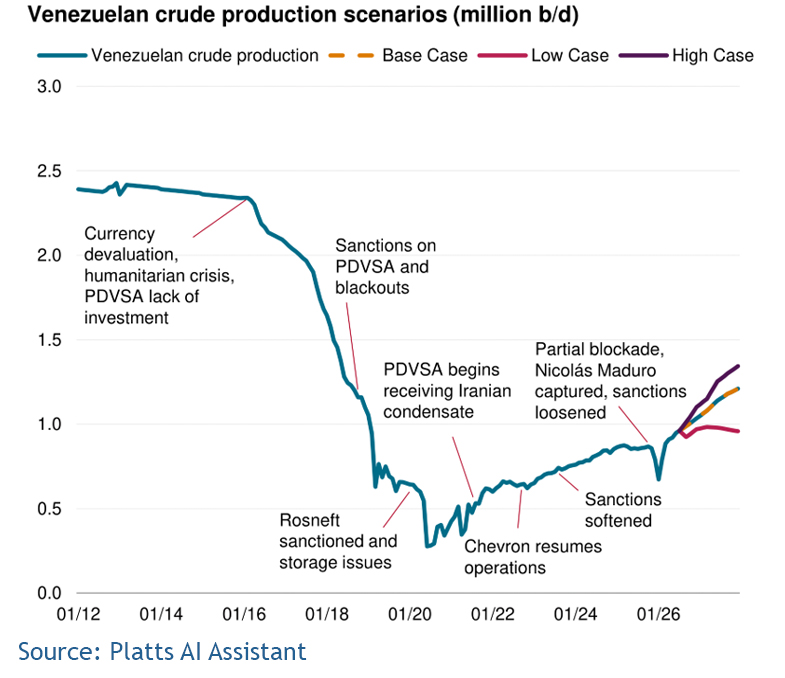
- U.S. officials are evaluating pathways that could more than double Venezuelan oil production, potentially creating a meaningful new source of global crude supply over the next several years.
- Despite the upside potential, aging infrastructure, underinvestment, and operational challenges remain significant obstacles to achieving sustained production growth.
Venezuela’s oil sector is attracting renewed market attention as U.S. officials discuss scenarios that could more than double the country’s crude production in the coming years. A successful expansion would represent a significant source of incremental supply for global oil markets and could help offset production declines elsewhere while improving availability of heavy crude grades. However, the path to higher output remains uncertain. Years of infrastructure deterioration, limited investment, equipment shortages, and operational disruptions have constrained Venezuela’s ability to restore production capacity.
While policy support and increased investment could accelerate development, rebuilding upstream operations, processing facilities, and export infrastructure will require substantial time and capital. As a result, market participants are closely watching whether announced ambitions can translate into actual production gains. The pace of Venezuela’s recovery could become a crucial factor influencing regional crude flows, global supply balances, and longer-term oil market fundamentals.
Hurricane Season Adds Another Layer of Risk to Tight Product Markets
- Gulf Coast refining and logistics remain vulnerable as Hurricane season enters its peak period.
- Any major disruption could quickly increase already-tight diesel and refined-productbalances.
Hurricane season is adding another layer of uncertainty to an already constrained refined-product market. While the 2026 Atlantic season has been relatively quiet so far, September remains a key period for tropical activity, and Tropical Storm Edouard recently made landfall along the Gulf Coast. A stronger storm could force refinery shutdowns, disrupt offshore production, restrict vessel traffic, and create logistical bottlenecks across the Gulf Coast.
The timing is particularly important for diesel, with global supplies already expected to remain tight into the winter and refiners operating at elevated utilization rates. Even a temporary reduction in Gulf Coast refining or transportation capacity could tighten U.S. inventories further and push regional rack prices higher, particularly across markets dependent on Gulf Coast supply.
Strategic Petroleum Reserve Falls to Lowest Level Since 1982
- SPR inventories have fallen to just 285.4 million barrels, leaving the U.S. with its smallest emergency crude cushion in more than four decades.
- Rebuilding the reserve will take time, limiting Washington’s flexibility during another major supply disruption.
The U.S. Strategic Petroleum Reserve (SPR) has fallen to 285.4 million barrels, its lowest level since November 1982, after another 1.2 million-barrel draw last week. The reserve is now less than half of its roughly 714-million-barrel capacity, significantly reducing the government’s ability to respond to a major supply disruption with emergency crude releases.
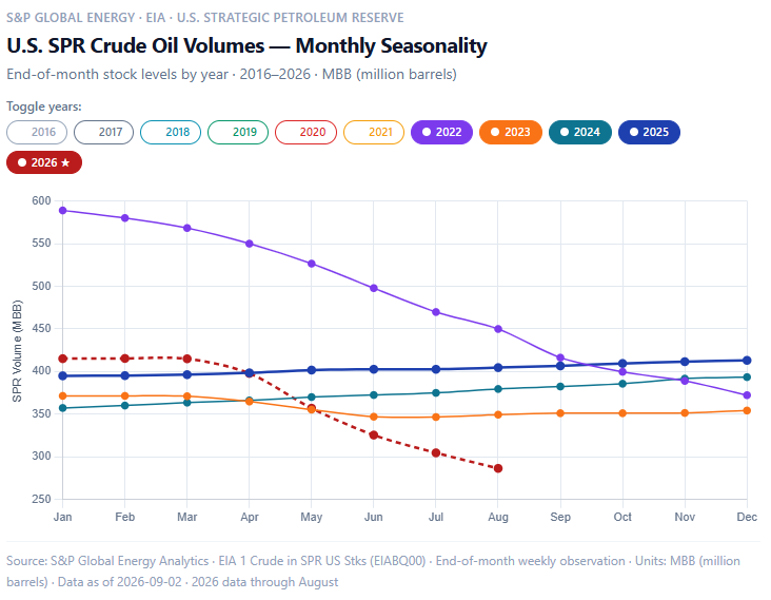
The U.S. Strategic Petroleum Reserve (SPR) has fallen to 285.4 million barrels, its lowest level since November 1982, after another 1.2 million-barrel draw last week. The reserve is now less than half of its roughly 714-million-barrel capacity, significantly reducing the government’s ability to respond to a major supply disruption with emergency crude releases.
Sources:
- Energy Information Administration (EIA)
- Trading Economics
- GasBuddy
- Fox Business
- S&P Platts